
Users
Real Estate Buyers, Sellers, Agents, Internal Product, Data & Platform Teams
Industry
Real Estate / PropTech
Product Stage
Production-Grade Data Access & Integration Platform (Legacy + Modern Coexistence)
RETS Server Integration
On paper, modern MLS APIs appear to solve the problem of listing data access. In practice, large portions of the real estate ecosystem still rely on RETS (Real Estate Transaction Standard) as a primary or fallback mechanism for data distribution.
This work focused on integrating RETS servers as a first-class data source alongside MLS APIs, ensuring reliable coverage, backward compatibility, and continuity across markets where modern APIs were incomplete, inconsistent, or unavailable.
The goal was not to replace MLS APIs, but to build a resilient data access layer that reflected real-world MLS maturity.
Context and Scope
The platform depended on comprehensive and timely listing data across multiple regions. While some MLS organizations offered modern REST-based APIs with robust documentation and support, others still exposed data primarily or exclusively through RETS.
Even where MLS APIs existed, they often varied in feature completeness, historical depth, or reliability. Certain datasets, such as historical listings, extended attributes, or media metadata, were more consistently available through RETS than newer APIs.
From a platform perspective, treating RETS as optional would have resulted in data gaps, inconsistent user experiences, and limited market coverage.
Why RETS Was Still Required
Technical Perspective - RETS servers exposed richer and more stable data contracts in many markets.
They supported large-scale historical queries, incremental data retrieval via timestamps, and consistent schemas that had evolved over long periods of operational use. While less developer-friendly, RETS often provided better guarantees around completeness and backward compatibility.
RETS also allowed tighter control over synchronization logic. By querying based on modification timestamps and resource classes, the platform could reconstruct listing lifecycles more reliably in markets where push-based APIs were noisy or incomplete.
From a technical standpoint, supporting RETS was essential for:
-
Full historical backfills
-
Reliable incremental updates
-
Consistent lifecycle reconstruction
-
Market parity across regions
Ignoring RETS would have meant building a platform optimized for ideal conditions rather than actual ones.
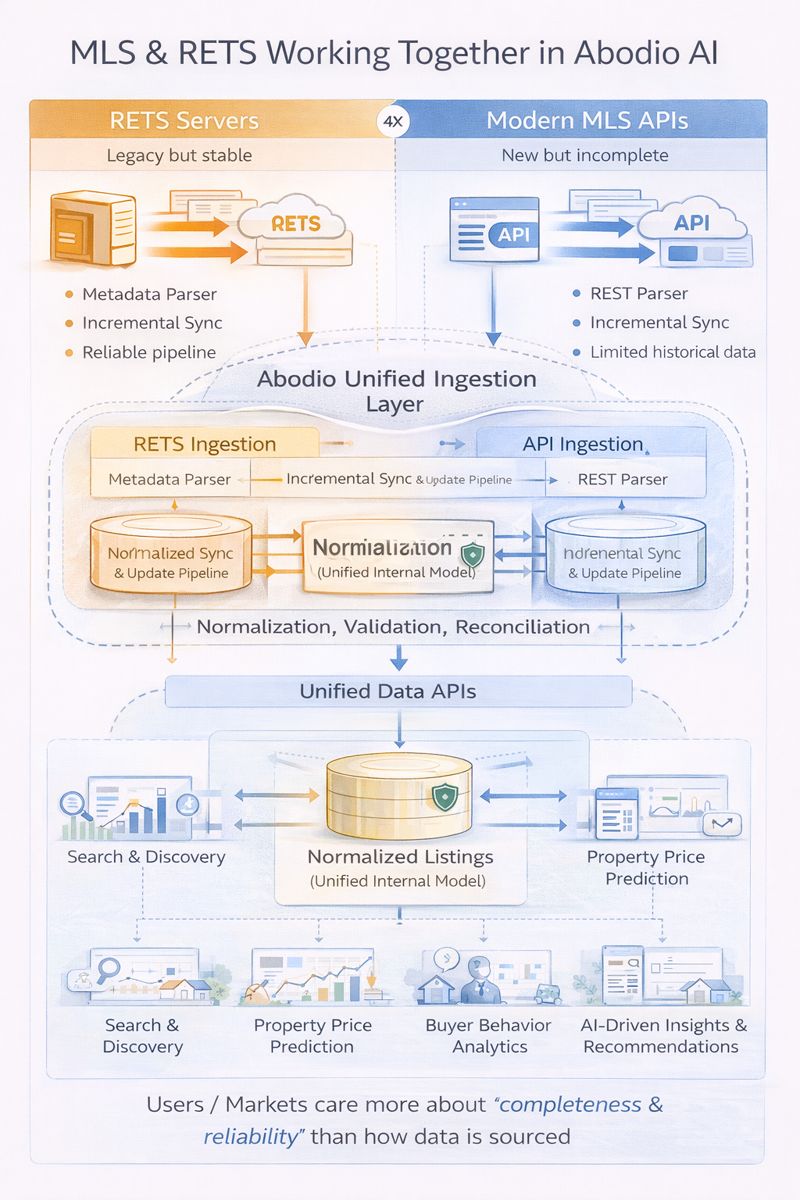
Market Perspective - From a market and customer perspective, data reliability mattered more than protocol modernity.
Users expected complete listings, accurate statuses, and consistent historical context regardless of how the underlying data was sourced. Missing properties or partial histories undermined trust far more than the technical elegance of the integration.
Supporting RETS enabled the platform to operate in markets that competitors relying solely on modern APIs could not enter or fully support. It also allowed faster onboarding in regions where MLS API access required longer approval cycles or imposed stricter usage constraints.
In effect, RETS integration expanded market reach and credibility, even though it added technical complexity behind the scenes.
The Problem
RETS integration is non-trivial.
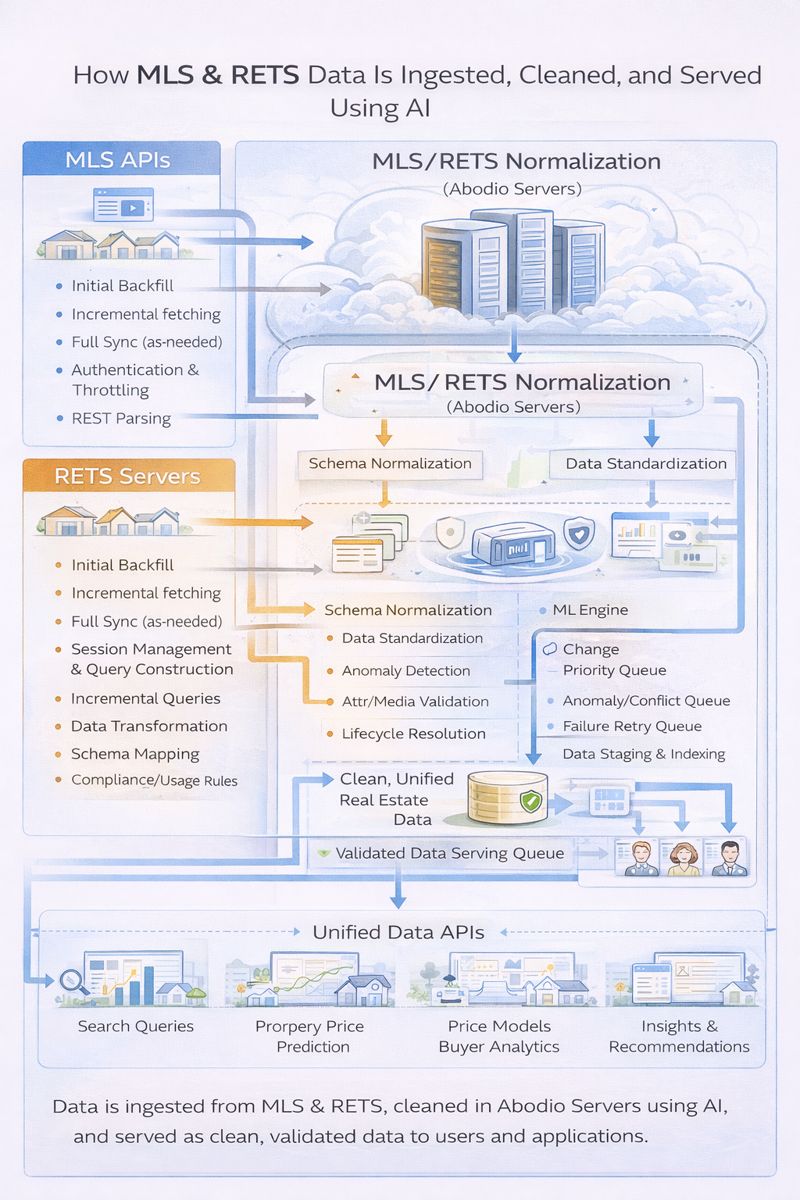
Unlike modern APIs, RETS required session-based authentication, metadata-driven schema interpretation, and careful query construction to avoid timeouts or throttling. Data formats were verbose, and error handling was often opaque.
The challenge was building a RETS integration that was robust, maintainable, and abstracted away from downstream product teams without allowing legacy complexity to leak into the rest of the platform.
My Role
I owned the product strategy and technical integration approach for RETS support.
That included deciding when RETS should be used as a primary source versus a supplementary one, defining synchronization strategies, and aligning RETS ingestion with the platform’s unified data model.
I also worked closely with compliance considerations to ensure RETS usage aligned with MLS rules around data access, storage, and display particularly where RETS and API terms differed subtly.
Critically, I treated RETS as a platform concern, not a one-off integration.
Integration Architecture & Product Decisions
Rather than exposing RETS directly to product consumers, the platform abstracted RETS behind the same internal interfaces used by MLS APIs.
Metadata parsing translated RETS schemas into normalized internal models. Incremental sync logic reconciled RETS updates with API-driven updates where both existed. Conflict resolution rules ensured consistent listing state when signals diverged.
This approach allowed downstream systems such as search, analytics, AI models, to remain agnostic to whether data originated from RETS or APIs.
Risks
Legacy systems fail differently than modern ones.
RETS servers could be slow, unstable, or inconsistently configured across markets. Poorly constructed queries could impact system performance or trigger access restrictions.
To manage this, the integration emphasized conservative query strategies, robust retry logic, and explicit monitoring of sync health and data freshness.
From a product perspective, the biggest risk was allowing legacy complexity to constrain innovation. That risk was mitigated by strict abstraction boundaries and clear ownership of ingestion semantics.
Go-To-Market
RETS integration was not marketed explicitly.
Instead, its value was expressed through coverage, reliability, and consistency. The platform could support more regions, onboard markets faster, and maintain historical depth that competitors struggled to match.
From a GTM standpoint, RETS quietly enabled scale — allowing the product to promise reliable market data without caveats or regional exceptions.
Outcomes
Supporting RETS alongside MLS APIs significantly improved market coverage and data completeness.
The platform was able to maintain consistent listing histories, reduce gaps in availability, and operate reliably across regions with varying levels of MLS technical maturity.
Most importantly, RETS integration prevented platform growth from being gated by the slowest-moving MLS organizations.