
The Universal Commerce Protocol (UCP): Re-architecting Commerce for an AI-First World
What UCP Is, Why It Exists, and Where It Fits
Why Commerce Reached a Structural Breaking Point
The Assumption That Quietly Broke
For the last two decades, digital commerce has been built on a single, largely unquestioned assumption: the human is the executor of transactions.
Systems were optimized around that assumption. Discovery interfaces were designed for browsing. Checkout flows were designed for manual confirmation. Error handling assumed human judgment. Post-purchase processes relied on customer support to resolve ambiguity.
This assumption was never explicitly stated, but it shaped everything from UX patterns to backend architecture.
That assumption is now broken.
Not because humans disappeared from commerce, but because execution is no longer exclusively human. AI agents are increasingly capable of discovering products, evaluating constraints, optimizing trade-offs, and completing transactions on behalf of users. The interface has shifted from pages to intent. The actor has shifted from hands to systems.
The moment execution moves away from humans, the existing commerce stack reveals a structural flaw: it was never designed to be executed by machines.
The Universal Commerce Protocol exists because of that break.
It is tempting to frame recent changes in commerce as incremental evolution: better recommendations, smarter search, more personalization. That framing is incomplete.
What has actually happened is a role inversion.
Historically, commerce systems presented options and humans executed decisions. AI reverses that relationship. Systems now increasingly execute decisions, while humans supervise outcomes.
This inversion exposes a mismatch. Most commerce systems are:
- Implicit rather than explicit
- UI-driven rather than contract-driven
- Forgiving rather than deterministic
- Optimized for interpretation rather than execution
These properties work when humans are in the loop. They fail when agents are.
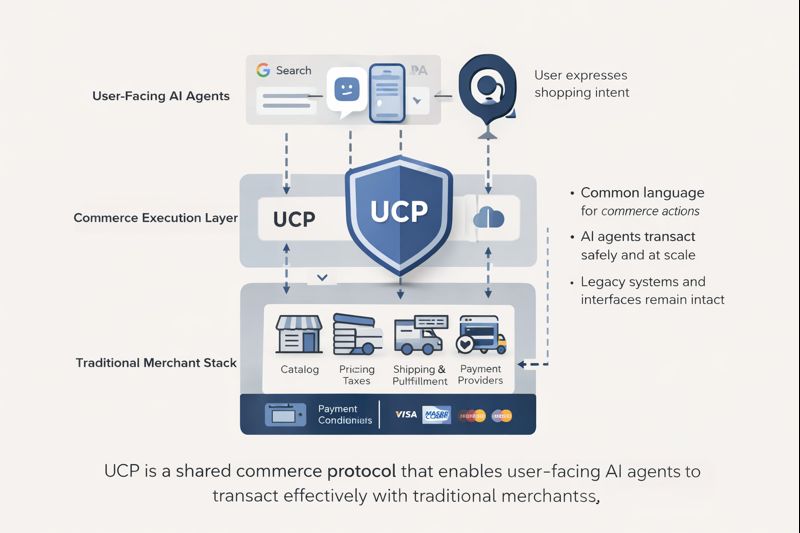
UCP does not attempt to “modernize” commerce UX. It addresses a deeper issue: commerce lacks a machine-executable contract layer.
Why AI Interfaces Alone Were Never Enough
Early AI commerce experiments followed a predictable path. Language models were used to:
- Interpret shopping intent
- Summarize products
- Compare options
- Generate recommendations
Some went further, attempting to orchestrate checkout flows through inferred API calls or browser automation.
These experiments demonstrated something important: intent interpretation was not the hard part.
Execution was.
The moment money, inventory, fulfillment, and policy enforcement entered the picture, systems that relied on inference rather than contract began to fracture. Errors were rare enough to ignore at small scale, but impossible to govern at large scale.
The problem was not intelligence. It was lack of structure.
UCP emerges precisely at this fault line. It does not attempt to make AI “smarter.” It assumes intelligence is already sufficient. What was missing was a way for intelligence to act safely.
Commerce Is a Distributed System, Whether We Admit It or Not
Modern commerce is not a monolith. It is a distributed system spanning:
- Catalog and pricing engines
- Inventory systems
- Tax and shipping services
- Payment processors
- Order management platforms
- Logistics providers
- Customer support tooling
Humans smooth over inconsistencies between these systems through judgment and patience. Machines cannot.
In distributed systems, ambiguity is a liability. Protocols exist to eliminate ambiguity. They define:
- What actions are allowed
- What inputs are required
- What outputs are guaranteed
- What happens when things go wrong
Commerce, despite its complexity, never developed a universal execution protocol because it did not need one as long as humans were doing the work.
Agentic execution changes that calculus.
UCP treats commerce as what it always was: a distributed system that finally needs a shared execution language.
Why This Protocol Could Not Have Emerged Earlier
It is worth asking why a protocol like UCP did not appear ten years ago.
The answer is not technological immaturity. APIs, schemas, and authentication frameworks existed. What did not exist was a credible non-human executor.
Without agents capable of end-to-end reasoning and delegation, a universal execution protocol would have been unnecessary overhead. Humans could already navigate ambiguity faster than systems could formalize it.
AI agents changed the economics.
When execution can be delegated reliably, the value of formalization outweighs the cost. Ambiguity stops being flexible and starts being expensive. Informal exception handling becomes technical debt.
UCP is not a speculative protocol. It is a response to a threshold being crossed.
What UCP Actually Introduces (At a Structural Level)
At its core, UCP introduces one missing abstraction:
commerce capabilities as explicit, machine-executable contracts.
Rather than exposing commerce through pages or ad-hoc APIs, UCP defines canonical capabilities such as:
- Product discovery
- Checkout session creation
- Payment authorization
- Order lifecycle management
- Post-purchase actions
Each capability is described using structured schemas that define not just data shape, but behavior:
- Required inputs
- Permissible state transitions
- Error semantics
- Ownership boundaries
This is a critical distinction. UCP is not just data normalization. It is behavior normalization.
Agents do not guess how checkout works. They invoke checkout as a capability. Merchants do not teach each agent their flow. They publish what they support.
This is how automation scales.
The Shift From Interfaces to Capabilitiesing
One of the most underappreciated implications of UCP is how it reframes competition.
Interface-driven commerce rewards persuasion: layout, copy, visual hierarchy. Capability-driven commerce rewards operational clarity: accuracy, reliability, policy coherence.
When agents act on behalf of users, they do not “browse.” They evaluate constraints. They select paths with the least uncertainty. They prefer systems that behave predictably.
UCP accelerates this shift by making capabilities legible and comparable.
This does not eliminate branding or experience, but it moves them upstream. Trust is earned through consistency, not presentation.
Governance Becomes Continuous by Necessity
Another structural consequence of agent-executed commerce is the collapse of episodic governance.
In traditional commerce:
- Policies are reviewed quarterly
- Edge cases are escalated manually
- Failures are investigated post-hoc
In agentic commerce:
- Decisions execute continuously
- Errors propagate instantly
- Signals feed back into selection models in near-real time
UCP forces organizations to confront this reality. By making execution explicit, it removes the illusion that governance can remain occasional.
This is uncomfortable. It is also unavoidable.
UCP as a Consequence, Not an Initiative
It is important to frame UCP correctly.
UCP is not a product strategy.
It is not a platform land-grab.
It is not a UX innovation.
It is the natural consequence of a structural shift in who executes commerce.
Once that shift is accepted, the need for a protocol layer becomes obvious. The only open question is whether organizations adapt deliberately or reactively.
Execution Is the New Interface
Every major commerce transformation has followed the same pattern:
- New actor enters the system
- Existing assumptions break
- Infrastructure adapts
Catalogs adapted to malls. Malls adapted to websites. Websites adapted to mobile.
Agentic commerce is the next actor. UCP is the infrastructure response.
The organizations that understand this early will not just integrate a protocol, they will redesign how their systems express intent, enforce policy, and execute decisions.
Re-architecting Commerce for an AI-First World
Why AI Interfaces Alone Cannot Scale Commerce
The Real Question Is Not “Can AI Shop?”
By the time most organizations seriously evaluate UCP, they have already answered the wrong question.
They have asked whether AI can assist with shopping. They have experimented with conversational discovery, product summarization, comparison tables, and even limited transactional flows. These experiments often look impressive in demos. Some even show early traction.
The real question, however, is not whether AI can shop.
The real question is whether commerce systems can safely, deterministically, and repeatedly execute transactions when the primary actor is no longer human.
This distinction matters. AI interfaces solve the interpretation problem. Commerce systems must solve the execution problem. The gap between the two is where most early AI-commerce initiatives quietly break down.
UCP exists to close that gap.
Why AI-Mediated Commerce Breaks at Scale
Early AI commerce experiments rely on a simple pattern: use a language model to interpret user intent, infer the necessary steps, and then orchestrate a series of actions across merchant systems. When constrained to low-risk scenarios, this approach works well enough to appear viable.
The failure modes only emerge at scale.
Commerce systems are unforgiving. They encode financial commitments, legal obligations, inventory constraints, and post-purchase responsibilities. They do not tolerate ambiguity. They do not tolerate partial execution. They do not tolerate inconsistent state.
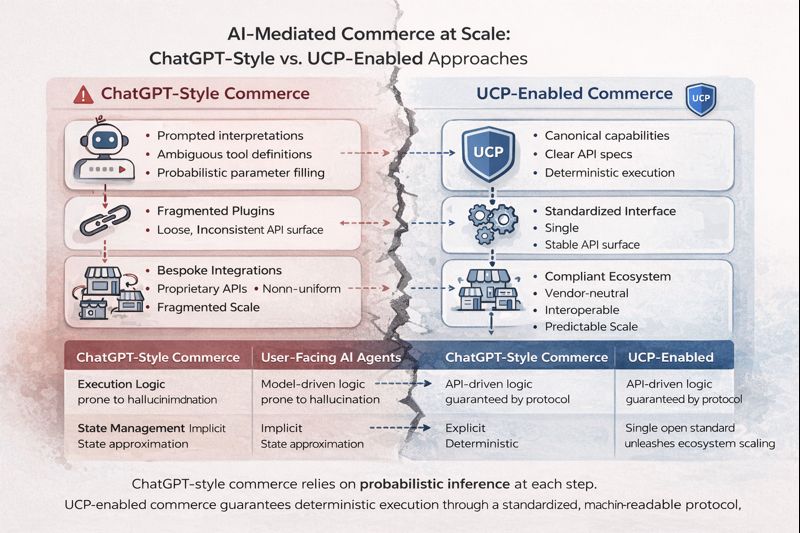
AI-mediated orchestration, by contrast, is probabilistic by nature. Even when structured outputs or function calls are used, the model remains responsible for:
- Assembling parameters
- Sequencing actions
- Interpreting intermediate responses
- Handling retries and errors
This creates a fragile coupling between probabilistic reasoning and deterministic systems.
At small scale, errors are rare enough to be ignored or manually corrected. At large scale, they compound. Duplicate charges, orphaned orders, inconsistent totals, and silent failures stop being edge cases and start becoming systemic risk.
The problem is not that AI is “bad at commerce.”
The problem is that commerce requires guarantees that probabilistic systems cannot provide on their own.
Commerce Is a State Machine, Not a Conversation
One of the most subtle but consequential misunderstandings in AI-commerce design is treating commerce flows as conversational sequences rather than state machines.
Conversations tolerate ambiguity. Commerce does not.
A checkout process is not a dialogue. It is a series of state transitions governed by strict invariants:
- A cart exists or it does not
- Inventory is reserved or it is not
- A payment is authorized once, not twice
- An order moves forward or backward, never sideways
Humans navigate these constraints intuitively through UI affordances and error messages. Machines must navigate them explicitly.
When AI systems attempt to infer state transitions dynamically, they assume responsibility for correctness without the tools to enforce it. This is why early agentic commerce implementations either:
- Over-restrict behavior to avoid risk, or
- Accumulate hidden technical and operational debt
UCP formalizes commerce flows as explicit, machine-readable state transitions. Instead of inferring how checkout works, agents invoke a checkout capability with defined inputs, outputs, and error semantics. State ownership remains with the merchant system, not the AI.
This is not an implementation detail. It is the architectural distinction that makes large-scale automation possible.
Determinism Is Not Optional in Financial Systems
In most software systems, occasional inconsistency is inconvenient. In commerce systems, it is existential.
A single duplicate charge can erase trust. A missed refund can escalate into regulatory scrutiny. A misreported delivery date can trigger cascading support costs.
AI-mediated inference cannot provide determinism by design. Even when the same prompt is issued twice, outputs may vary. Even when outputs are constrained, interpretation remains contextual.
UCP exists to remove interpretation from execution.
Instead of asking an AI to decide how to perform an action, UCP defines:
- What actions exist
- How they are invoked
- What guarantees they provide
- Who owns the result
The AI’s role is reduced to intent resolution and action selection. Execution is handled by systems built for determinism.
This separation mirrors how modern distributed systems evolved. We do not ask services to infer protocols at runtime; we define contracts and enforce them. Commerce is no different.
Why State Ownership Must Remain Outside the Agent
One of the most dangerous temptations in agentic commerce is allowing the agent to “own” transaction state.
This usually starts innocently. The agent tracks what has been added to a cart. It remembers the user’s preferences. It attempts to reconcile partial failures. Over time, the agent accumulates responsibility that belongs elsewhere.
This is how systems drift into inconsistency.
UCP enforces a clear boundary:
- Agents reason
- Merchants execute
- Platforms orchestrate
- Payment providers secure
State lives where it can be audited, recovered, and governed.
By making checkout sessions, orders, and lifecycle events first-class protocol objects, UCP prevents state from leaking into layers that cannot guarantee correctness.
This design is not accidental. It reflects decades of hard-won lessons from payments, logistics, and infrastructure engineering.
Privacy and Trust Are Structural, Not Policy-Driven
In AI-mediated commerce, privacy failures are rarely caused by bad intentions. They are caused by unclear boundaries.
When AI systems touch payment flows without explicit role separation, sensitive data inevitably spreads beyond its intended scope. Logs grow noisy. Tokens are reused incorrectly. Responsibility becomes diffuse.
UCP addresses privacy by constraining what each participant can see and do.
Payment credentials are never exposed to agents. Authorization occurs through tokenized instruments scoped to a single transaction. Merchants process payments through existing PSP integrations without learning anything about the user beyond what is necessary to fulfill the order.
This preserves existing compliance models rather than inventing new ones.
More importantly, it preserves user trust. Delegating purchases to an agent only works if users believe delegation does not mean surrendering control. UCP makes that belief defensible.
Monetization Emerges Above the Protocol, Not Inside It
Another reason UCP has been misunderstood is the assumption that it exists primarily to monetize AI-driven shopping.
That assumption confuses protocols with platform strategies.
Protocols define how systems interact. Platforms decide how to monetize interactions.
UCP deliberately avoids embedding monetization logic. It does not dictate ranking, bidding, commissions, or advertising models. It defines execution, not incentives.
This is precisely why it is adoptable.
Merchants do not integrate UCP to give up margin. They integrate it to remain executable in an agent-first environment. Platforms may layer monetization on top, but that is a separate strategic decision.
By separating protocol from monetization, UCP avoids the zero-sum dynamics that doomed earlier attempts to centralize commerce control.
The Hidden Shift: From Interface Control to Capability Competition
Perhaps the most profound implication of UCP is how it changes competition.
When commerce is interface-driven, advantage comes from:
- Visual design
- Copywriting
- Funnel optimization
- Behavioral nudges
When commerce is capability-driven, advantage comes from:
- Reliable availability signals
- Predictable fulfillment
- Clear policies
- Low exception rates
UCP accelerates this shift.
Merchants compete less on how they present themselves and more on how well their systems behave under constraint. This is uncomfortable for organizations optimized around marketing and experience design. It is empowering for organizations that invest in operational excellence.
This is not a moral judgment. It is a structural consequence of automation.
Why UCP Is the Missing Layer, Not the Final Answer
UCP does not solve every problem in agentic commerce. It does not decide which products to show. It does not determine pricing strategy. It does not eliminate platform power dynamics.
What it does is make execution legible.
Without a protocol layer, AI-commerce initiatives either stall under their own risk or fragment into bespoke integrations that do not scale. With a protocol layer, execution becomes predictable enough for real adoption.
UCP is not the destination. It is the prerequisite.
Execution Is the Bottleneck
Most AI discussions focus on intelligence, how well systems understand intent, context, and nuance. Commerce fails because of execution.
The organizations that win in agentic commerce will not be the ones with the most eloquent AI. They will be the ones whose systems can execute intent reliably, repeatedly, and at scale.
Applications, Integration Strategy, and What Businesses Must Decide Now
Where UCP Actually Shows Up in the Commerce Lifecycle
By the time most leaders encounter UCP, they are already thinking in terms of integration effort and ROI. That instinct is understandable, but premature. UCP is not something you “add” to an existing funnel. It reshapes how the funnel itself behaves.
To reason about its impact, it is useful to walk through the commerce lifecycle end to end and identify where UCP changes behavior in ways that are not immediately obvious.
Discovery no longer belongs to pages
In a UCP-enabled world, discovery increasingly happens inside agent interfaces rather than merchant-controlled surfaces. This does not mean merchants disappear from discovery, but it does mean that product information must be legible to machines first, and humans second.
Catalog quality becomes strategic infrastructure. Ambiguous SKUs, inconsistent attributes, and poorly defined availability that might be tolerable on a website become liabilities when agents are making decisions autonomously. The cost of bad data shifts from mild UX friction to outright exclusion from consideration.
Merchants who invest in structured, accurate, real-time catalog signals are rewarded disproportionately. Those who rely on visual merchandising alone gradually lose visibility as agents prioritize determinism over persuasion.
Comparison becomes constraint satisfaction
Human shoppers browse. Agents solve constraint problems.
When an AI agent evaluates products using UCP, it is not scrolling through grids; it is evaluating whether a product satisfies explicit constraints like price ceilings, delivery windows, compatibility requirements, return policies, sustainability preferences, and so on.
This subtly but profoundly changes competition. Merchants are no longer competing on who looks best in a grid; they are competing on who best satisfies the user’s constraints with the least uncertainty.
In practice, this means policies matter as much as products. Shipping reliability, cancellation flexibility, and post-purchase support stop being footnotes and become ranking signals.
Checkout becomes a capability, not a page
UCP’s most visible impact is on checkout, but the real shift is conceptual. Checkout is no longer a UI flow optimized for humans; it is a capability invoked by an agent.
This has consequences. Totals must be computable deterministically. Taxes and shipping must be resolvable without ambiguity. Edge cases that previously relied on customer support intervention must be formalized.
Merchants who have accumulated years of exception handling embedded in human workflows are often surprised by how much implicit logic has to be made explicit for agentic execution.
Post-purchase is no longer an afterthought
Because UCP defines order lifecycle events explicitly, post-purchase interactions like shipping updates, delays, returns, refunds, they become part of the agent experience.
This raises the bar. Poor post-purchase handling no longer hides behind email inboxes and support queues; it feeds back into agent trust models. Merchants who underinvest in post-purchase systems may find themselves deprioritized long before they realize why.
What Businesses Actually Gain by Integrating UCP
Most platform shifts promise efficiency. UCP does too, but its real value lies elsewhere.
Reduced acquisition friction
Agent-mediated commerce dramatically reduces friction between intent and execution. Fewer steps mean fewer drop-offs. For merchants, this often translates to higher conversion on high-intent purchases without incremental marketing spend.
Higher intent quality
Because agents operate on explicit constraints, the traffic they generate is often pre-qualified by design. Users who delegate purchases tend to be clearer about what they want. This reduces browsing noise and support burden.
Operational signal clarity
UCP surfaces operational quality signals like availability accuracy, delivery reliability, return rates etc, in a way that is hard to ignore. While this can feel punitive, it also creates a clear roadmap for improvement. Merchants finally see which operational weaknesses are actively costing them demand.
Future proofing against interface shifts
Perhaps the most important benefit is strategic optionality. Integrating UCP does not force merchants to abandon existing channels. It ensures they are not structurally excluded as interfaces evolve.
This is not about chasing the next channel. It is about ensuring your systems are legible to whatever comes next.
The Integration Question Is the Wrong First Question
When leaders ask, “How hard is it to integrate UCP?”, they are often looking for a technical estimate. The more important question is what kind of organization you need to be for the integration to succeed.
UCP integration exposes organizational seams mercilessly.
Data ownership must be clear
Catalog data, pricing logic, inventory availability, and fulfillment signals often live in different systems owned by different teams. UCP forces these signals to be consistent and authoritative. If your organization cannot agree on which system is the source of truth, integration will stall.
Exception handling must be formalized
Humans are excellent at handling ambiguity. Systems are not. UCP requires edge cases to be defined upfront. This often reveals how much of a business’s operational resilience depends on informal human intervention.
Governance must shift from episodic to continuous
Once agentic commerce is live, behavior changes continuously. Policies cannot be reviewed quarterly. Pricing errors propagate faster. Inventory mismatches are surfaced immediately. This requires governance models that assume constant change rather than periodic review.
Organizations that treat UCP as a one-time integration project are often unprepared for the ongoing operational discipline it demands.
Risks and Failure Modes Most Teams Underestimate
UCP is not risk-free, and pretending otherwise is irresponsible.
Loss of experiential control
Merchants accustomed to carefully curated experiences struggle with the idea that agents may summarize, reorder, or omit aspects of their brand presentation. This is a real loss, not an imagined one.
The trade-off is reach and relevance. Refusing to accept mediated presentation does not preserve control; it simply cedes it to competitors willing to adapt.
Over-optimization for agents
There is a temptation to “game” agent ranking systems by overfitting to constraints. This can lead to brittle strategies that collapse when signals change. Sustainable advantage comes from operational excellence, not optimization tricks.
Dependency on platform interpretation
Even with open standards, platforms interpret signals differently. Merchants must monitor how their capabilities are being consumed and be prepared to adapt. Blind trust is as dangerous here as outright resistance.
Internal resistance
Perhaps the most common failure mode is internal. UCP challenges entrenched assumptions about ownership, branding, and customer interaction. Teams that built careers optimizing funnels and interfaces may feel threatened. Successful adoption requires leadership to frame UCP as evolution, not replacement.
A Pragmatic Adoption Path (What Actually Works)
In practice, successful UCP adoption follows a predictable pattern.
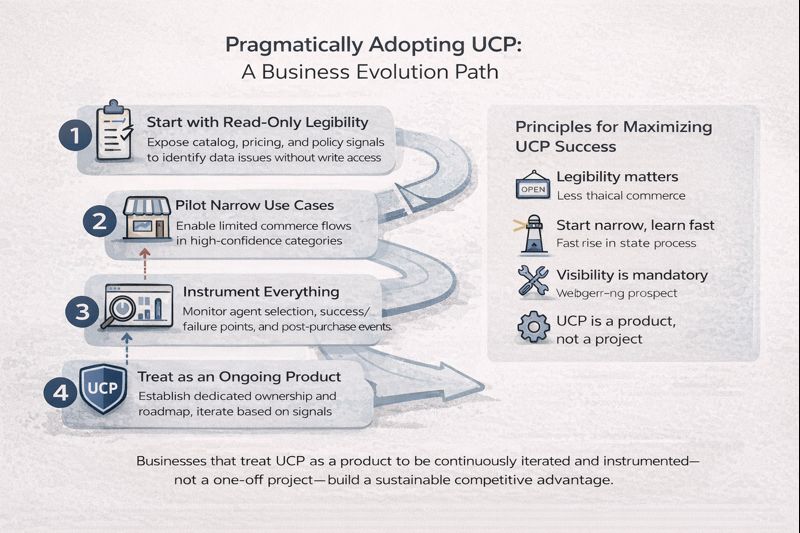
Start with read-only legibility
Before executing transactions, merchants benefit from making their catalogs, pricing, and policies legible to agents without enabling checkout. This surfaces data quality issues early without financial risk.
Pilot narrow use cases
Rather than enabling full-spectrum commerce, early pilots focus on constrained categories or fulfillment models where operational predictability is high. This allows teams to build confidence incrementally.
Instrument everything
Agent-mediated commerce is opaque unless instrumented deliberately. Merchants need visibility into:
- Why products were or were not selected
- Where flows broke
- How post-purchase events influenced future selection
Without this, learning stalls.
Treat integration as a product, not a project
The most successful teams assign product ownership to UCP integration. Roadmaps evolve. Feedback loops are established. The integration is iterated, not “completed.”
What UCP Reveals About the Future of Commerce
Stepping back, UCP is best understood not as a protocol, but as a forcing function.
It forces commerce systems to be explicit.
It forces organizations to confront their operational reality.
It forces leaders to decide how much control they are willing to delegate in exchange for relevance.
Commerce has always adapted to new interfaces like catalogs, malls, websites, mobile apps. Agentic commerce is simply the next interface shift, but it is qualitatively different because the interface is no longer HUMAN.
UCP does not create this future. It acknowledges it.
The Cost of Waiting Is Structural, Not Tactical
It is tempting to treat UCP as something to watch, experiment with, or revisit later. That instinct is understandable, especially for organizations already stretched thin by digital transformation initiatives.
But the cost of waiting is not measured in missed features. It is measured in structural misalignment.
As agents become primary buyers, systems that cannot speak to them fade from consideration, not because they are worse, but because they are illegible. No amount of branding can overcome invisibility.
The Universal Commerce Protocol offers a path forward that preserves merchant autonomy while enabling agentic execution. It is not perfect. It will evolve. It may even be superseded. But the principles it encodes. Principles like explicit capability, deterministic execution, clear ownership, are here to stay.
For leaders willing to engage with those principles now, UCP is an opportunity. For those who ignore them, it is a warning.
